1 500 light bulbs, footage from New York’s Grand Central Station, and one fundamental mathematical problem: how do you map an image onto light bulbs randomly positioned in space? That is how Scattered Light came to be – one of the most celebrated works by Jim Campbell, an MIT graduate and Guggenheim Fellow whose pieces hang in the collections of MoMA and the Metropolitan Museum of Art in New York. He is bringing the installation to Signal Festival: a quiet kind of magic that you have to discover for yourself.
Your academic background lies in technical fields. How did you find your way to art?
I studied electrical engineering and mathematics, but about ten years after graduating and working in Silicon Valley, I started to get a little bored with engineering. Gradually, over the course of twenty-five years, I began leaning more towards art – film-making in particular. Around 1988–1990, when I started combining my interest in film with my engineering knowledge. That’s why most of my works are described as “custom electronics” – I generally design the electronics in my pieces myself.
Could you walk us through the engineering of Scattered Light?
Scattered Light was a way of continuing to work with a 2D image after years of working in two dimensions, while having the representation be three-dimensional. It’s essentially about translating a 2D image into 3D.
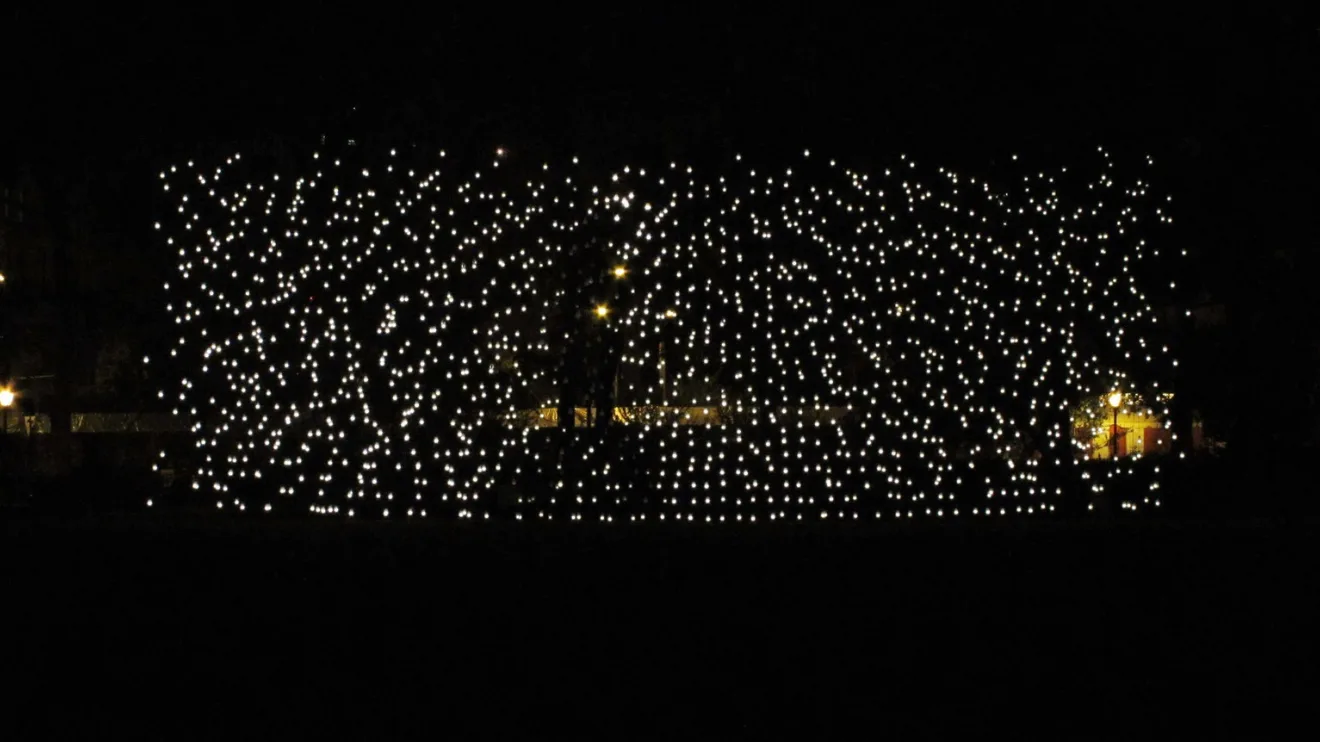
The technically most challenging part was what I call the “map” – the bulbs hang from above at random positions, and the problem was figuring out how to map the image onto them. That took the most time. I start with an image, which I convert to low resolution – in this case 64 pixels wide by 24 pixels high. I then randomly “stretch” it along the Z axis, creating a kind of cloud of lights.
The tricky part is that mathematically generated randomness doesn’t actually look random – your eyes start following patterns and clusters. So a second step was needed, where I went through the positioning manually to make the result feel random, not just be mathematically random.
So Scattered Light was the first work where you moved from 2D to a 3D object of this kind?
Yes. Scattered Light was the first piece where I truly extended an image into the Z axis.
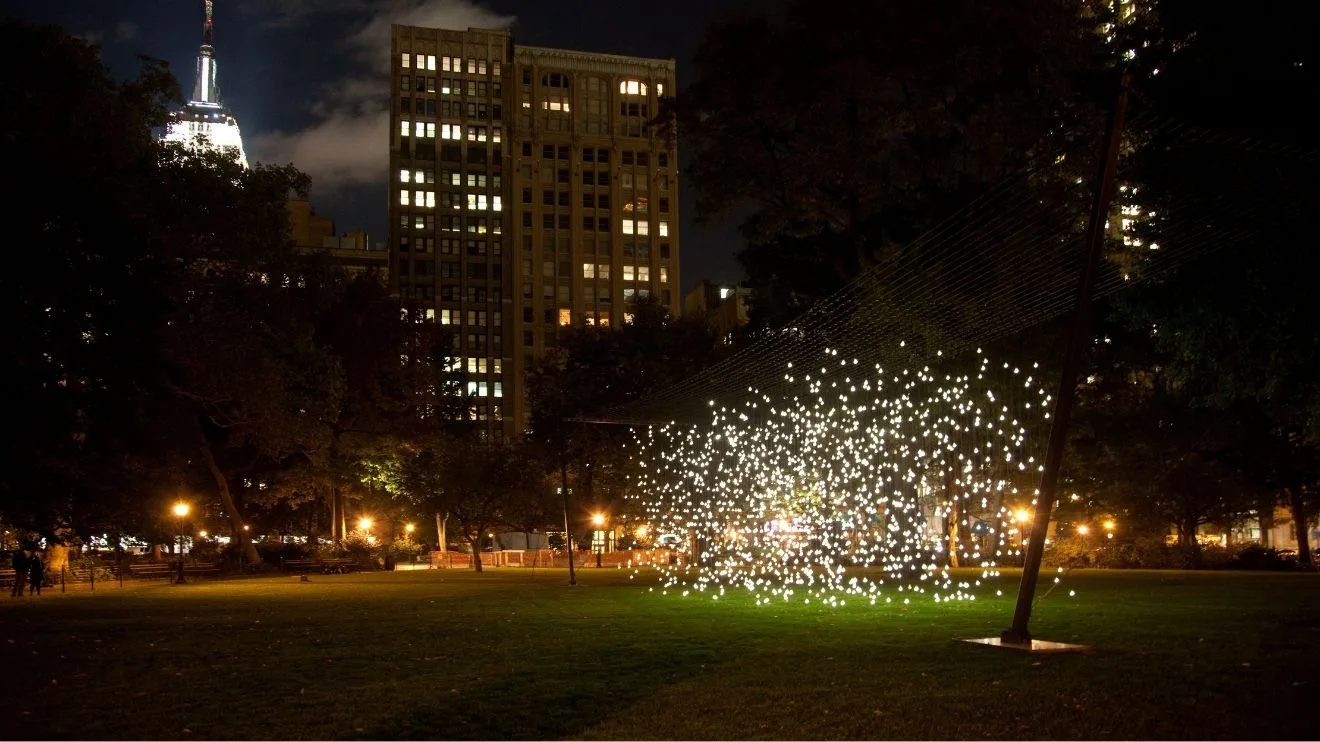
I was very nervous at the first showing in Madison Square Park, because for the image to be recognizable, viewers had to stand about 20 metres away – any closer and the work just looks like a cluster of light bulbs. There was no way to test that in advance, but fortunately it worked.
On your website I read that the work uses footage from Grand Central Station. Does that choice carry any particular message?
Two things, really. First, moving human silhouettes are very easy to recognise – almost in a primal, ancient sense, like shadows by a fire in a cave. That’s why I work with figures in many of my pieces. Second, the movement at Grand Central Station is wonderfully chaotic, with people going in all directions at once. When I shoot on the street, people walk back and forth along the same paths. Grand Central is different – and that felt ideal for this type of work. It wasn’t so much about the content of the place, but about the way people move there.
I also shot there for earlier, flat works. I love the chaos and the energy. In the morning you get commuters – moving fast, dressed in black. At eleven o’clock you get tourists – more colourful, slower, getting lost. I love how the place changes throughout the day.
Has Scattered Light been shown anywhere else besides Madison Square Park?
Yes, it has travelled to several places. From New York it went to Minneapolis–Saint Paul in Minnesota, where it was installed by the river. Then to Perth in Australia. Then to Hong Kong, and about four years ago to Durham in England. Four or five locations over sixteen years.
In Hong Kong the piece had bad luck – it was supposed to be on show for two months, but after just two days the worst hurricane in many years hit, and the work was completely destroyed. We had to rebuild it entirely. Generally it holds up well – in New York it survived six months of a harsh winter with strong winds and snow without any problems. A hurricane, though, is a different category.
Do you enjoy showing work in parks?
Yes, I love placing the work in parks. Mixing it with nature rather than architecture suits its random, organic quality. So I’m really glad you found a park location in Prague.
How do people interact with the work?
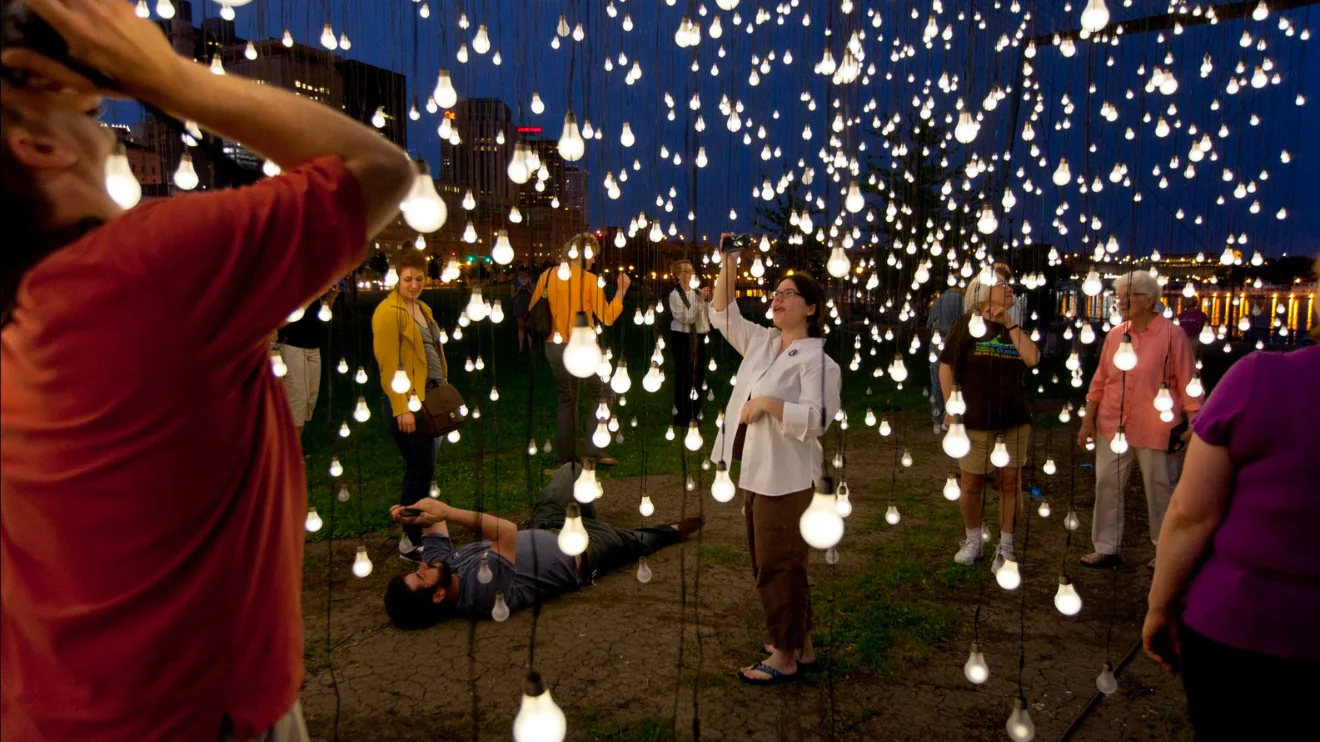
Mostly by moving closer and then stepping back again. A lot of people don’t realise that the closer they get, the less clear the image becomes – it’s the opposite of what they’d expect. There’s a kind of dance with distance.
Also, if you look at the work from the side, you see nothing but flickering lights. The image is only visible from the front and the back; as you move off-axis it becomes increasingly abstract.
Why did you choose LED bulbs?
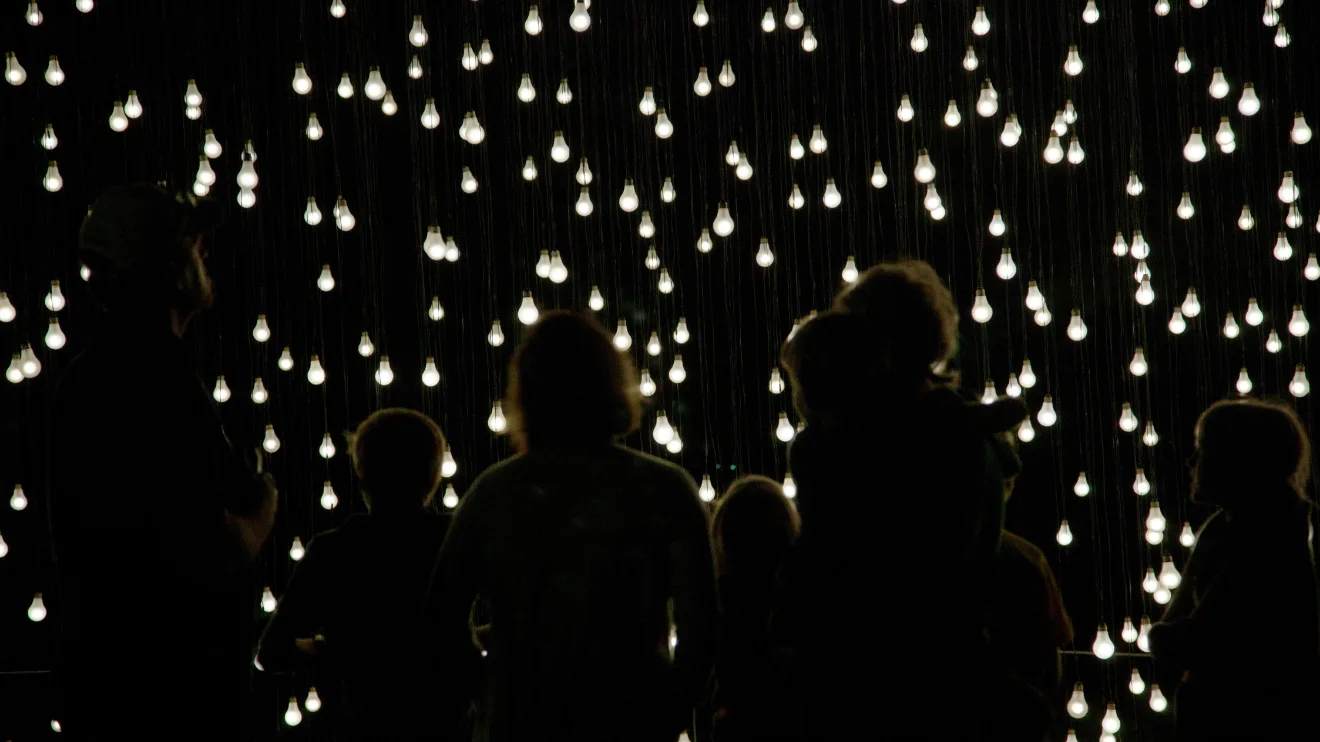
Standard bulbs would draw far too much power. So we cut open all 2,000 bulbs one by one and replaced the filament with a custom-made LED, so the work draws much less energy. Then we put the glass back on, and the result is a soft glow that feels like an old-fashioned light bulb.
The hardest part of the whole process is cutting the glass – we use a tile saw. A lot of them break in the process.
What is the greatest magic of Scattered Light?
I love the moment when someone doesn’t notice the work at all at first – and then they see someone else staring at it, they look too, and suddenly they say: “Oh my god, there’s an image in there.” It’s a kind of magical awakening. I think it will be a really powerful experience for people. You’re looking at a bunch of light bulbs, and then suddenly there’s an image.
And because the bulbs are so light and sway gently in the wind, it has a very airy, delicate feel.
About Scattered Light
At first glance, Jim Campbell’s Scattered Light appears as a monumental constellation of suspended bulbs blinking softly in the dark. But as visitors step back and allow their eyes to adjust, fleeting human figures begin to emerge from the glow – ghostly silhouettes passing through the space, only to dissolve once more into an abstract structure of light.
The installation transforms a moving image into a three-dimensional environment built from more than 1,500 points of light. It captures an everyday scene of people moving through a busy transit hub, yet it can only be perceived from a certain angle – with each step a visitor takes, it breaks apart, shifts, and reassembles. By unfolding a two-dimensional image into physical three-dimensional space, Campbell creates a unique perceptual paradox.
About Jim Campbell
Jim Campbell was born in 1956 in Chicago. After studying mathematics and engineering at MIT, he moved to San Francisco, where in the mid-1980s he transitioned from film-making to interactive video installations. Since 2000 he has worked primarily with LED technology as his central medium. His electronic sculptures and installations have established him as a leading figure in the use of computer technology as an art form – Campbell explores the boundary between representation and abstraction, and investigates the human capacity to interpret information and “fill in the gaps” necessary to form a coherent image.

Campbell’s work has been exhibited worldwide and is held in the collections of some of the world’s most significant institutions, including the Museum of Modern Art, the Whitney Museum of American Art, and the Metropolitan Museum of Art in New York, as well as the Smithsonian American Art Museum in Washington, D.C. His awards include the Rockefeller Foundation Fellowship Award in multimedia and the Guggenheim Fellowship Award.